
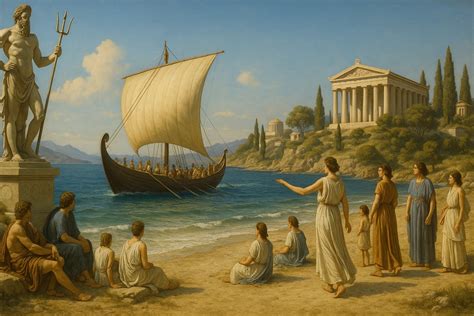
Xenia is one of those ideas that doesn't translate cleanly into English, which is a sign it's worth exploring. In the Odyssey, it's often rendered as hospitality, but that undersells it. It's also a version of the golden rule: treat others as you would like to be treated.
Xenia was closer to a sacred obligation. It was Zeus's immutable law for civilised people: A stranger arriving at your door, with no credentials and no introduction, was to be fed, sheltered, and treated with real generosity before you even asked their name. The obligation ran both ways, host and guest, and the gods themselves were said to travel in disguise specifically to test whether it was being honoured. Treat a beggar badly, and you might have insulted Zeus himself, without even knowing it.
“We're at your knees In hopes of a warm welcome, even a guest-gift, The sort that hosts give strangers. That's the custom. Respect the gods, my friend. Were suppliants – at your mercy! Zeus of the Strangers guards all guests and suppliants: Strangers are sacred – Zeus will avenge their rights!”
Homer, The Odyssey, p220
The Odyssey uses Xenia as a kind of moral instrument, a way of showing you exactly who someone is, before their actions make it obvious. When Odysseus, still disguised, finally reaches his own house after twenty years, it's Eumaeus the swineherd, the lowest ranked person in the household, who takes him in without question and treats him with real warmth. Contrast this with the suitors, who occupying Odysseus's hall, mock the stranger at their door and even throw a stool at him! Homer doesn't need to tell you which household has lost its way. The treatment of the stranger has already told you.
I think the concept of Xenia is a useful lens for looking at a culture, any culture, a team, a company, even a family. Not what the mission statement says, but how people act. How do the people with the least power, the least seniority, the least established, actually get treated by the people around them? A new hire in their first awkward week. A junior person whose idea gets talked over in a meeting. Someone who doesn't yet know the unwritten rules and asks the question everyone else stopped asking years ago. What happens to them tells you more about an organisation's real values than any framed poster in reception.
It's worth noticing that in the Odyssey, Xenia isn't really about grand gestures. Eumaeus doesn't have much to offer, a modest meal, a place to sleep, his own cloak against the cold, and he gives it without hesitation anyway. The suitors have everything, all of Odysseus's wealth in fact, and give nothing but contempt. Generosity toward someone unproven is not about resources. It is about character, the actions of the giver, often in the moment when nobody else is watching closely enough to reward them for it.
How do you treat the people in your world who are new, uncertain, or not yet proven? Not the people who've already earned your attention. The ones still waiting to. What you do there, says a lot about what your culture actually is, as opposed to what you'd like to believe it is.
This is just one of the themes I explore in my Odyssey programme for Leaders. Come for a free introductory evening on the 4 November in Shoreditch, The Odyssey: Nobody Trained Us for What Was to Come. Come for the story, stay for the conversation, leave with a few new questions for work.