
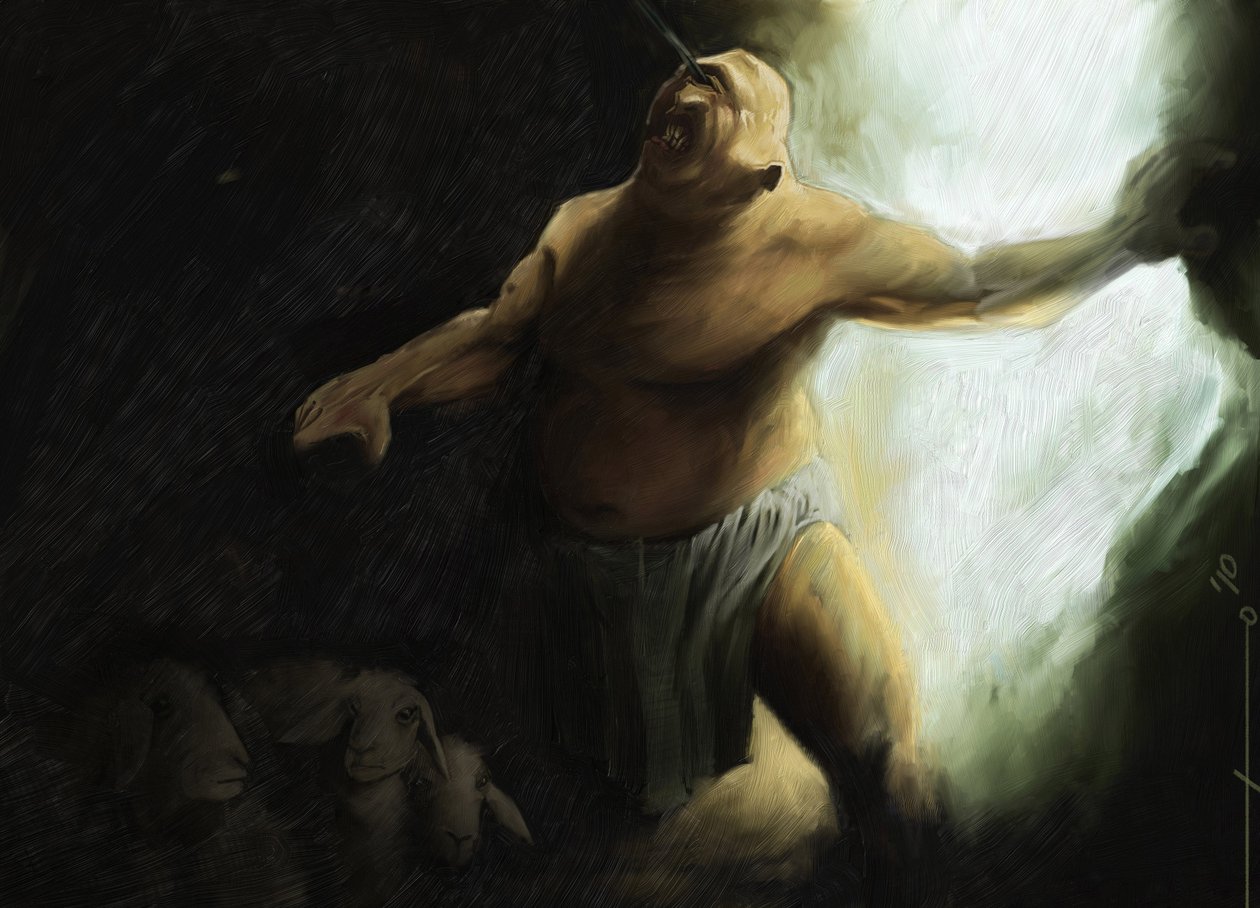
In the ninth book of the Odyssey, Odysseus and his crew find themselves trapped in the cave of Polyphemus, a one-eyed giant who has already eaten two of his men and shows no sign of stopping. Odysseus does not fight his way out. He thinks his way out. All while his men are panicking in terror and they are literally at risk of imminent death. He remains clear-headed.
He tells the Cyclops his name is Nobody, gets him drunk, and blinds his single eye while he sleeps. When the other Cyclopes come around, startled by Polyphemus's screams, they ask who has hurt him? And Polyphemus can only shout "Nobody is hurting me," and so they leave him to his pain. It is one of the great escapes in literature, built entirely on cleverness rather than force.
“That Nobody... Tell me where that scoundrel is cringing from my rage! I'd smash him to the ground, I'd spill his brains –”
Homer, The Odyssey, p225
Then Odysseus ruins it. He reaches for grandeur... As his ship pulls away from the island, he cannot resist shouting his real name back at the giant. Odysseus needs Polyphemus, and the gods, to know exactly who outsmarted him. That single boast gives the Cyclops and his father, Poseidon the Earth-Shaker, a name to curse. The rest of the Odyssey, ten more years at sea, follows directly from that one moment of ego winning out over judgement.
I am reminded of the Cyclops incident when I'm working with a leader whose great triumph has become their curse. They are convinced of their own brilliance... And it's not without merit: The instinct that built their reputation; the certainty that got them promoted; the single clear vision that cut through the noise when the organisation needed it most. These traits don't disappear when they stop being useful. They keep operating. Unchecked, these traits may start working against them.
Like the Cyclops, a single eye sees one thing very clearly. It also has no peripheral vision at all. And even the great Odysseus couldn't see his future.
The pattern is familiar in rooms full of senior people. Someone's conviction, which once rallied a team through a genuine crisis, hardens into an inability to hear dissent. Someone's decisiveness, prized when speed mattered, becomes a habit of deciding before anyone else has finished speaking. The strength does not fade. It calcifies. And because it has worked before, because it is genuinely part of what makes that person good at their job, it is one of the hardest things to question, in ourselves or in each other.
There is a second, quieter lesson in that final boast.
Odysseus had already won. He was free, his crew was alive, the danger was behind him. He risked all of it, and paid for it with a decade, for the sake of being known as the one who did it. And he was already the most famous human warrior of the age! The need for credit, for the story to be correctly attributed to its author, is its own kind of blindness, and it rarely strikes when we are struggling. It strikes right when we are safe, and tempted to make sure everyone knows how we got there.
Where has your own strength started working against you lately? Not the places where you feel weak, those are usually easy to spot and easy to forgive. The places where you still feel strong, still feel right, still feel like the smartest person in the room. Those are worth a second look.
This is just one of the stories I explore in my Odyssey programme for leaders. Come for a free introductory evening on 4 November in Shoreditch, The Odyssey: Nobody Trained Us for What Was to Come. Come for the story, stay for the conversation, leave with a few new questions for work.