
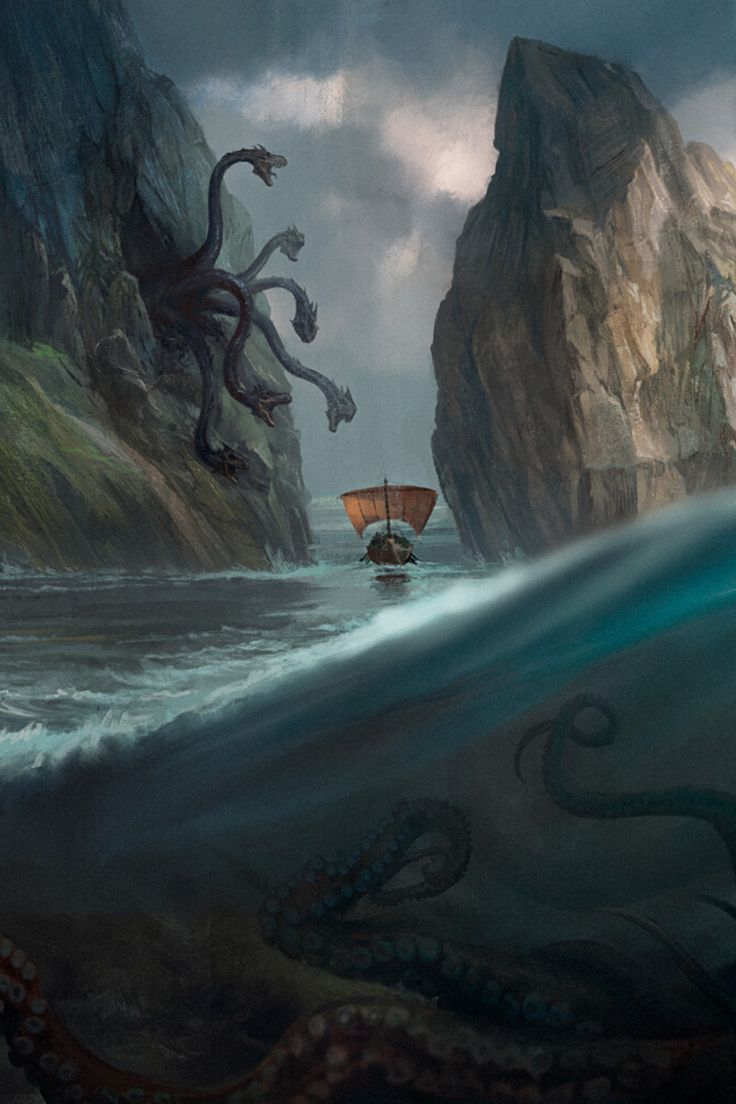
Circe gives Odysseus the clearest piece of advice anyone offers him in the entire poem, and it is not reassuring. Ahead lies a narrow strait. On the one side, Scylla, a six headed monster who will reach down and take exactly six of his men, one in each mouth, and nothing more. On the other side, Charybdis, a whirlpool that will swallow the entire ship and everyone on it.
Circe's instruction is brutally direct: steer toward Scylla. Lose six men on purpose, with full knowledge of what you're choosing, rather than gamble the whole ship on the slim chance of slipping past Charybdis untouched.
“Scylla's no mortal, she's an immortal devastation... Waste any time, arming for battle beside her rock, I fear she'll lunge out again with all of her six heads And seize as many men. No, row for your lives”
Homer, The Odyssey, p275
There is no version of this choice where Odysseus comes out clean. He cannot save everyone. He cannot even pretend the outcome is in doubt, Circe has already told him exactly what will happen even if he tries to fight the beast. What she's given him isn't a way to avoid loss. It's a way to choose which loss, with his eyes open, and then live with having chosen it. When the moment comes, he doesn't tell his crew what's about to happen. He watches six of his men get taken, screaming his name, and he keeps the ship moving. Homer doesn't let him, or the reader, look away from what that costs him and his men.
Most of the genuinely hard decisions I see leaders face these days are looking more like Scylla and Charybdis than they hoped. There is no "right" answer hiding somewhere, waiting to be found with enough analysis. Two real costs, clearly visible, neither of them acceptable, with a decision required regardless: Which product line to deprioritise, knowing good people's work gets quietly ended; Which market to exit, knowing it costs relationships you built over years; Who stays and who doesn't, when the honest answer is that the organisation cannot carry everyone through what's coming.
What Circe offers Odysseus isn't comfort. It's clarity, and a case for choosing the bounded loss over the unbounded hesitation, even when the bounded loss is still genuinely terrible. A lot of indecision in leadership doesn't come from not knowing the right answer. It comes from refusing to accept that there isn't one, and searching for a version of the choice where nobody has to suffer.
What might be a Scylla and Charybdis choice in front of you right now? The one where you already know, if you're honest, that every path forward costs something real. The work isn't finding the option with no cost. It's choosing which cost you can actually stand behind, and then holding that line once you've made it, rather than quietly drifting back toward the whirlpool because the whirlpool, at least, lets you pretend you didn't choose it...
This is just one of the stories I explore in my Odyssey programme for Leaders. Come for a free introductory evening on the 4 November in Shoreditch, The Odyssey: Nobody Trained Us for What Was to Come. Come for the story, stay for the conversation, leave with a few new questions for work.